Nurturing Gratitude in November

I am reminded of this old hymn by Percival Chubb who was a founding member of the Fabian Society, (according to Google)  an influential British socialist organization that aims to advance the principles of democratic socialism via gradualist and reformist effort in democracies. He was born in 1860 and died in 1960. He immigrated to the United States in 1889. He wrote this hymn, entitled, We Lift our Heart in Thanks which I share with you now. 

We lift our hearts in thanks today for all the gifts of life;
and, first, for peace that turns away the enmities of strife.

And, next, the beauty of the earth, its flowers and lovely things,
the spring’s great miracle of birth, with the sound of songs and wings.

Then, harvests of its teeming soil in orchard, croft, and field;
but, more, the service and the toil of those who helped them yield.

And, most, the gifts of hope and love, of wisdom, truth, and right,
the gifts that shine like stars above to chart the world by night.

My take away will be to notice around me, both when we gather and when we are apart, how our beloved community fills me with thanksgiving coming and going. I hope to see them often this month.

~Lydia Patrick
Posted in Nurturing Gratitude, Uncategorized | Tagged | Leave a comment

The Compassion in Justice

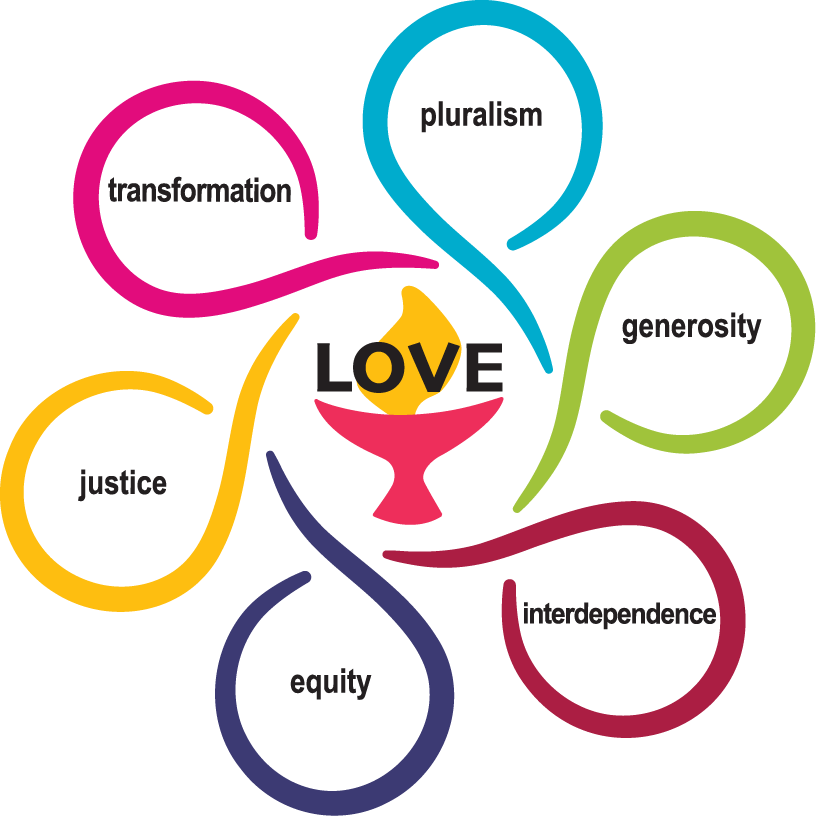
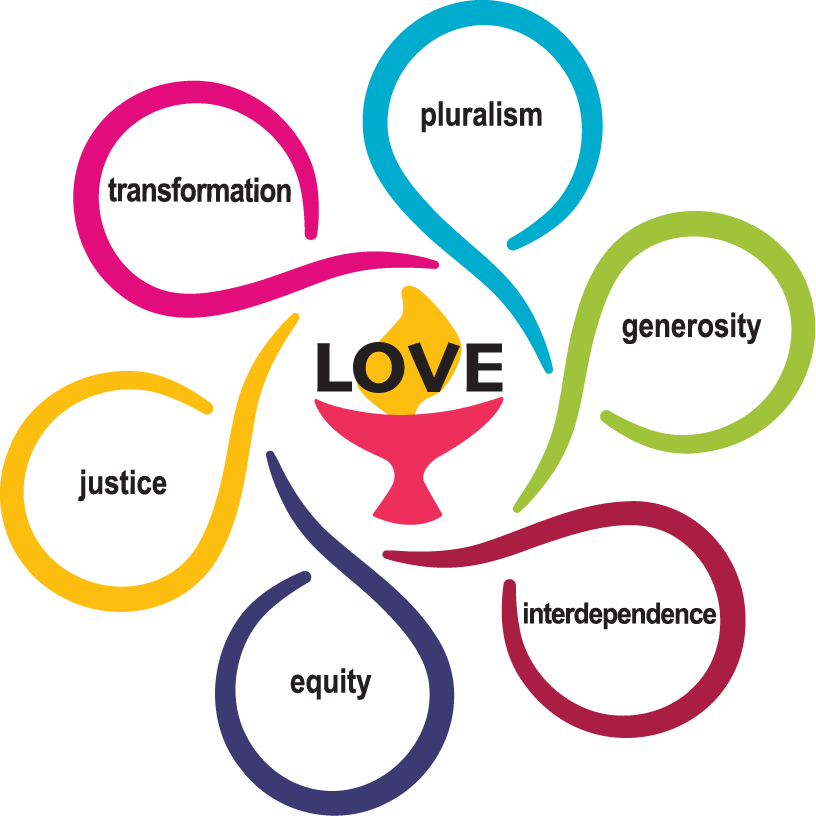
All of our Unitarian Universalist values, in one way or another, embody the dynamic of change. Among them, transformation, pluralism, generosity, interdependence, equity, and justice, with love at the center, certainly justice stands out as a value charged with the need for change.

Social justice has been an aspect of my life for most of my adult years. When we lived in Alabama, I went to midnight vigils in the MLK park in Birmingham each time the State put someone to death, because we stood for change in the death penalty laws. On Saturdays, I often joined a group at a major intersection downtown with signs protesting the war in Iraq because we wanted to change the destruction that was happening to an entire nation of people. For the better part of a decade, I taught Social Justice because I wanted to help change the perspectives of young minds on so many issues. We took our children and walked in HIV/AIDS walks, and then later Pride parades because we wanted to change the way LGBTQ people were viewed and treated in our communities.

I’ve participated in walks, marches, boycotts, letter writing campaigns, phone calling campaigns, teaching, learning, writing, preaching, yearning, longing, praying and meditating around justice issues–because change is needed. And in every single instance that I can list for things I’ve done, every single one of them is a change that my heart picks up as a familiar tug. The tug, the pull, the insistence of compassion. 

My experience of compassion invites me to consider your suffering, allows me to experience suffering together with you, requires me to notice your suffering, conjures my curiosity about how I might respond to your suffering, and calls me to be courageous in league with you about the suffering we hold together. 

Compassion is a hard work to respond to. For all that I’ve listed above, I cannot tell you a single issue that has completely changed for the good. Yes, there are steps and movements forward. There’s also (currently) loss of steps, regression to places I never thought we would revisit again. 

I think that’s why we hold justice as one of our most important values, as Unitarian Universalists. Change is needed. Compassion compels us. We find ways to respond.

~Bob Patrick

Posted in Cultivating Compassion | Tagged | Leave a comment

The Work of Compassion

Compassion is hard work. I think many of us see compassion as being something emotional and largely divorced from physical action. I believe it isn’t so simple. Our emotions and our
bodies are not separate things. Think of the last time you felt relief, joy, fear, or anxiety. I bet
you can name where in your body you felt each of those things, and perhaps just remembering
them creates an echo of that experience in your body now. Compassion is not only a thing we
feel, it is a thing that we do.

It can feel increasingly difficult to be compassionate towards some humans in recent years.
Perhaps it’s a neighbor or a coworker who feel they need to broadcast hurtful and harmful
opinions as if they are facts. Perhaps it is a loved one, a friend or family member, who isn’t
supportive of the principles that we, as Unitarian Universalists, hold central in our lives.
Compassion can feel like a slog when it seems the recipients of your compassion have none for
anyone else. Even when those for whom you experience compassion are deserving, grateful,
and reflect that compassion back towards you it’s possible to experience what’s called
compassion fatigue.

Compassion fatigue is increasingly being studied by the medical and veterinary communities
around the world, especially in the wake of the recent pandemic. It may feel like
physical/mental/emotional exhaustion. Like irritability, or cynicism. It could manifest as feelings of guilt, anxiety, or even as a sort of emotional detachment. If this sounds familiar, you are far from alone. To care deeply is to be open to this sort of wounds and exhaustion. But it is possible to be gentle and kind to oneself without abandoning those who need us. So the next time you are thinking of those beings who need your acts of compassion, remember yourself. You are equally deserving.

~Hannah Thompson

Posted in Cultivating Compassion | Tagged | Leave a comment

Just Doing Things To Help

I had to Google compassion because I  really didn’t know it’s meaning. It is almost the same as empathy except that you do something. An act of kindness is considered compassion. I learn things all the time.

 I started to remember  acts of kindness that I have done. I have cooked dinner for friends when they are not feeling well . When someone is feeling down and they just want someone to hear them, I’m all ears. I also leave a person alone when they want and need it. I’ve done many things that I never thought of as being compassionate. I was just helping people.

How many of you are like me? Just doing things to help someone and not thinking about it being compassion. But, it’s nice to know that an act of kindness is compassion. That would mean that most people are compassionate. That is nice to know.

~Rita Romero 

Posted in Cultivating Compassion | Tagged | Leave a comment

The Compassion in Equity

In some conversion on social media that I was involved with (I wish I could remember where so that I could give credit), I heard this proposition:  when privilege meets equality it experiences oppression.

When privilege meets equality it experiences oppression.

I heard this weeks ago, and it continues to return to me and invite me to consider how that may have played out in my life.

When I was in the second grade, public schools in Alabama finally relented and began integrating schools in accordance with federal law. On the weekend before that was to happen, I overheard adults talking (they did not know I could hear them). On the following Monday, black students from nearby black schools would be coming to our school which had been whites only up to that point. One of the adults insinuated that these students would likely be carrying knives. The implication was that we (white children) would be in danger. Of course, no such thing happened. 

Listen to the dynamic. When privilege (white people and their children) meets equality (public education is a right of all children), it experiences oppression (our children won’t be safe because they all carry knives). Notice how the oppression becomes “us and them” binary language. 

Consider public bathrooms and creating gender neutral bathrooms so that all people have access to them. When privilege (cis-gender people identifying as male and female) meet equality (provisions of public bathrooms that include trans and non-binary people) it experiences oppression (bathroom policing to ensure that predatory men dressed as women don’t hurt “our women”). You can run this through many situations and get an instantly clearer understanding of the dynamics at work.

When privilege meets equality it experiences oppression.

Our value of equity is a call and insistence that all people receive what they need to survive and thrive. For that to happen, change is required, and that’s where I see compassion entering into the work of equity. When we see a group of people not receiving what they need to survive and thrive, it requires the privileged to meet the demands for equity with a letting go, an opening up, and a willingness to expand rather than contract.

My experience of compassion invites me to consider your suffering, allows me to experience suffering together with you, requires me to notice your suffering, conjures my curiosity about how I might respond to your suffering, and calls me to be courageous in league with you about the suffering we hold together. 

~Bob Patrick

Posted in Cultivating Compassion | Tagged | Leave a comment

Finding Humanity in Prison Ministry

In college, I participated in my University’s chapter of Amnesty International, an international
non-governmental organization focused on human rights. While I was there, the chapter
prioritized opposition to the death penalty. The case of Troy Anthony Davis was a common
topic, and his story is important. Briefly, Troy Davis was a black man convicted of and sentenced to die for the 1989 murder of a police officer. Events during and after the trial led many to believe that this was a miscarriage of justice. Witnesses recanted statements, evidence and testimony were excluded, and physical evidence linking Davis to the crime was limited. People of note, including Jimmy Carter, petitioned the State for clemency. It was not granted, and Troy Davis was executed in 2011.

Questions swirled in my head and heart. Was Davis innocent? Did it matter? Why would we as
a society sanction the death of someone without absolute certainty that they committed the
offense? Why would we sanction death at all? I learned that Black men are disproportionately
represented in criminal convictions, on death row, and also in exonerations from death
sentences. I learned about structural and institutional injustice. I believed the death sentence
made sense in situations of heinous acts and absolute certainty. Then I believed that death
sentences were wrong because the only way to be absolutely certain innocent people are not
executed is not to execute anyone. Eventually, I concluded, as I now believe, that we cannot
condone killing.

I wanted to do something about it. I looked into groups like the Georgia Resource Center and
The Innocence Project, but I am not an attorney. My frustration with and opposition to the Prison Industrial Complex simmered for years until, after finding Unitarian Universalism and UUCG, I began to explore my values and search for ways to put them into practice. I saw a post on social media about the Church of the Larger Fellowship’s Worthy Now Prison Ministry and pen pal program. Here was a chance to put my values into practice, to recognize the humanity in the dehumanized, to make a big difference for a few people. Recognizing humanity is critical to compassion, but it does not mean approval or forgiveness. Many incarcerated individuals are victims of oppressive power structures. Others, bluntly, earned their removal from society.

The challenge in this work is to listen, to companion, and to care despite the other’s actions.
When you get started as a pen pal, it’s suggested that you don’t look into your person’s history.
Knowing the nature of their past actions can make connecting harder. I told myself I wouldn’t
look. One of them told me anyway. Their spirit of honesty and openness challenged me to work
to recognize their humanity and value the connection. I grappled with the difficulty made real by this reveal. I ended up being honest about this difficulty in return. I told my pen pal that I struggle with what was shared, but I promised to continue corresponding. I’m not here to judge or moralize. My role is to provide human connection and to listen. This is my spiritual work.

~Ian Van Sice

Posted in Cultivating Compassion | Tagged | Leave a comment

Love for Yourself

Many of us are taught to “love thy neighbor as thyself.” This phrase can be interpreted in several ways. For many folks, in our religion of origin, we are taught that loving ourselves is “selfish” or that we should place our focus on our own wants and needs last. My take on it is like the adage of the airplane in distress–where you are reminded to take the oxygen mask for yourself first, so that you can then be able to assist others in need of that same oxygen. If your needs are not being addressed, you won’t have the energy required to help others. You can’t pour from an empty cup.

I have experienced many days of these mixed messages with my family and religion of origin, From a young age I was expected to care for those around me despite my own needs being brushed aside. The message was that love for others was of utmost spiritual importance.
However, going through therapy beginning in my tween years, I learned that self-
compassion is the beginning of being truly able to care for others.

In the sacred texts of my youth, I remember the stories of Jesus where he went into places of solitude to reflect, rest and pray. To me, he was giving himself the same compassion he provided to those who were seeking him. I have found myself thinking, if that many people were asking for healing and getting their needs met from me constantly, I would want a break
from that too. I am finding that I struggle with that balance: giving self-compassion along
with giving compassion to others.

Do you struggle with self-compassion? If so, you’re not alone. What is one practice you can start today to show yourself some compassion in this hurting world?

~Jen Garrison

Posted in Cultivating Compassion | Tagged | Leave a comment